
 Scalp Health · Pillar
The complete guide to scalp health.
12 min read · May 2026Most haircare talks to the hair — the part that is already dead by the time you see it. A strand of hair is keratin, pigment and structure, finished and pushed out into the world. You can coat it, smooth it, and protect it, but you cannot change what it is. The living part of your hair is somewhere else entirely: in the skin it grew from. This guide is about that skin.
1. Your scalp is soil, not surface
It helps to borrow the language of a gardener. If your hair is the plant, your scalp is the soil — and no one who has grown anything believes you can fix a struggling plant by polishing its leaves. You look down. You ask what the roots are sitting in.
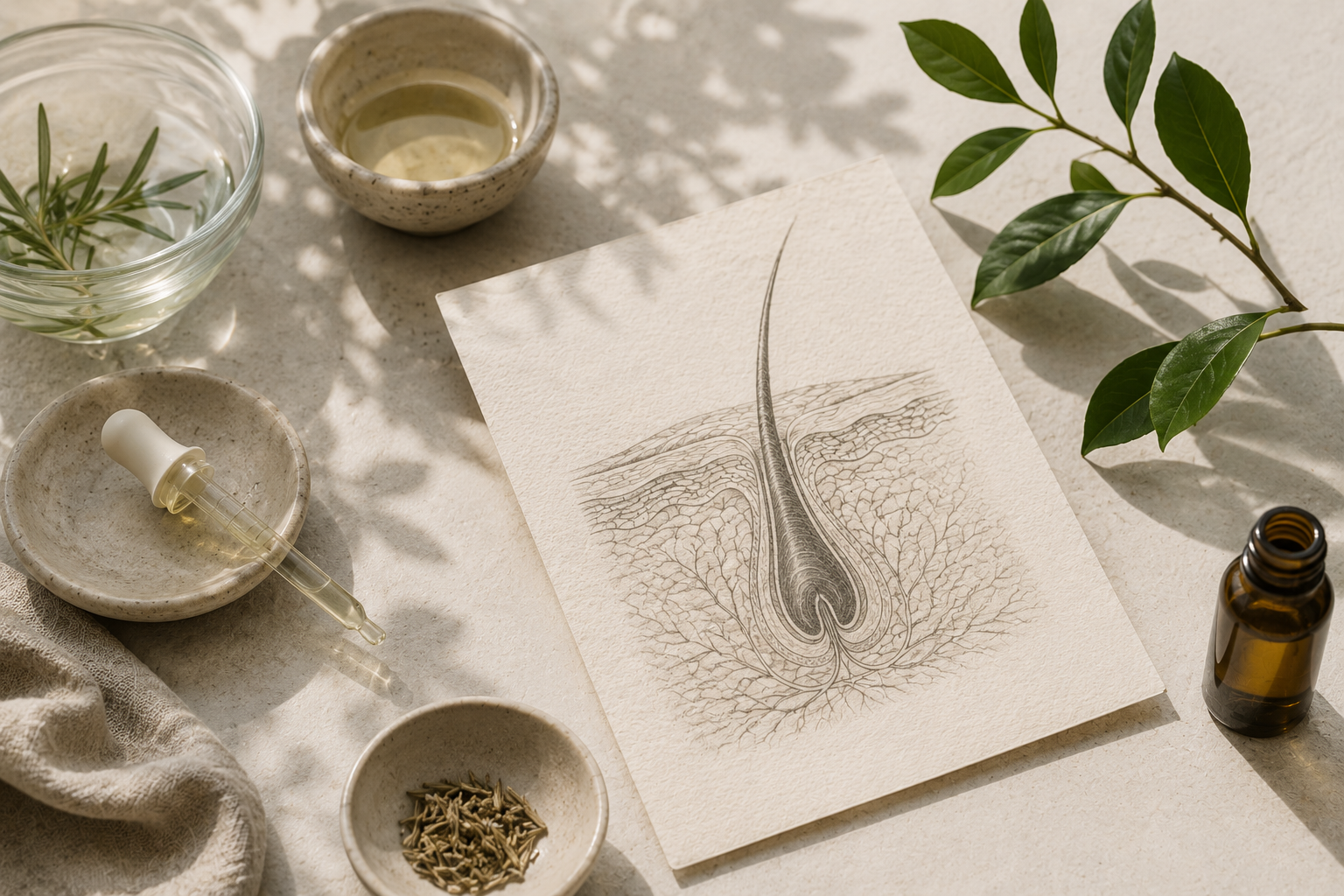
The scalp is skin, with all the same machinery as the skin on your face: a barrier of lipids and cells that holds moisture in and irritants out, oil glands that lubricate, a population of microbes that lives there by design, and — buried a few millimetres down — the follicles, the only structures on your body that manufacture hair. Everything you want from your hair is decided at that depth. The length, the density, the strength of each new strand: all of it is set before the hair ever reaches the air.
2. The barrier, the microbiome, the follicle
Three systems do most of the work, and they are easier to care for once you can picture them.
The barrier. The outermost layer of scalp skin is a wall of flattened cells held together by lipids — think bricks and mortar. When the mortar is intact, water stays in and the scalp feels calm. When it is stripped, by harsh surfactants or over-washing, water escapes, the scalp dries and tightens, and it often compensates by producing more oil. The greasy-but-tight scalp that so many people fight is usually a damaged barrier, not an oily one.
The microbiome. A healthy scalp is not sterile and is not supposed to be. It hosts a stable community of bacteria and yeasts that, in balance, keep each other in check. Most flaking and itch traces back to one resident yeast, Malassezia, overgrowing when conditions tip in its favour. The goal is never to scorch the surface clean — it is to keep the balance that was already there.
The follicle. Each follicle runs on a clock. It grows a hair for years (the anagen phase), rests briefly, sheds, and begins again. At any moment most of your follicles are growing and a small fraction are resting. Losing fifty to a hundred hairs a day is the clock working normally. Trouble shows up when too many follicles slip into the resting phase at once, or when the growing phase quietly shortens over years.
3. What goes wrong, and how to read the signs
Your scalp tells you what it needs, if you know how to read it.
- Tightness right after washing usually means the barrier has been stripped. The shampoo is too aggressive, or you are washing too often.
- Flaking with itch points to microbiome imbalance — the Malassezia story above — rather than simple dryness.
- Oiliness that returns within hours is often rebound: a barrier so stripped that the glands over-produce to defend it. Counterintuitively, washing less can calm it.
- Gradual widening of a parting, or a thinning hairline, is a follicle-phase story unfolding over months. This is slow by nature, which is exactly why it is so often noticed late.
None of these is solved by a better conditioner. They are all happening below the surface, in the soil.
4. Where oil fits (and where it doesn't)
A scalp oil is not a miracle and should not pretend to be. What a well-made oil does is specific and modest: it supports the barrier with lipids the skin recognises, it can carry an active botanical down to where the follicles sit, and the few minutes you spend massaging it in bring blood — and therefore oxygen and nutrients — to the surface.
That last part matters more than people expect. The massage is not a delivery gimmick; mechanical stimulation of the scalp has a real, measured effect on local circulation. The oil is partly a reason to slow down and do it.
What oil cannot do is rescue a scalp that is being stripped twice a day, or replace medical treatment for a genuine condition. It is one input among several — sleep, stress, washing habits, diet, and where relevant, a dermatologist. We would rather undersell it honestly than oversell it and lose your trust.
5. A simple weekly ritual
You do not need a ten-step routine. You need a few honest minutes, once or twice a week.
- Part and apply. On a dry or slightly damp scalp, part the hair and apply oil directly to the skin along the parting, not to the lengths. Make a few partings so you cover the whole scalp.
- Massage for five minutes. Use your fingertips, not your nails, in slow circles. This is the part that does the work. Set a timer if it helps you not to rush.
- Let it sit. Thirty minutes is plenty; overnight is fine if you protect your pillow. There is no extra reward for leaving it on for days.
- Wash it out properly. Oil needs a real wash to lift cleanly — see the case for a double shampoo for the method that does it without stripping.
6. A note on patience
Here is the thing no one selling you something wants to say plainly: the follicle clock turns in months, not days. A hair that begins growing healthier today will not reach a length you notice for a season. Anything that promises visible results in a week is talking about the surface — shine, slip, the feel of the strand — not the soil.
So the honest measure of a scalp ritual is not next week. It is whether, three months from now, you have kept it up. Make it small enough to keep, and the soil takes care of the rest.
Source: American Academy of Dermatology — Everyday scalp care. aad.org.
Put it into practice. Our single oil, Nourishing, is built for exactly this ritual: rosemary at a researched concentration in lightweight coconut MCT, made to be massaged into the scalp and washed cleanly out. Read about Nourishing →